|
3. Elliptical
movement
It is obvious that a
comprehensive study of celestial mechanics must include a rigorous
treatment of all possible orbital movement. However, as the main
objective of this article is only to give a general impression of
celestial mechanics without entering too much in its vast though
beautiful complexities, we shall only discuss to some detail the
elliptic orbits being the most general case and because all planets,
Moon and satellites (both natural and artificial) follow this type or
orbit.
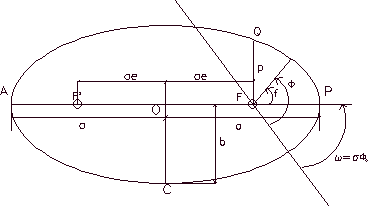
Figure 3.1
Through the use of basic analytic
geometry, it is easy to show that:
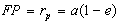 ; Pericenter distance (least
distance to the central body
3.1
; Pericenter distance (least
distance to the central body
3.1
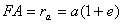 ; Apocenter distance (greatest distance to the central body)
3.2
; Apocenter distance (greatest distance to the central body)
3.2
Because the distance from the
center of ellipse to the foci is the product of the eccentricity and the
semi-major axis.
Also, because of a property of
the ellipse, we have that the semi-minor axis is:

By virtue of equation 2.5
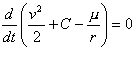
(conservation of the energy) we can deduce the velocity of a planet in
an elliptic orbit, as follows:
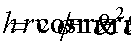 ; Remember that
=G(M+m)
; Remember that
=G(M+m)
Going back a bit in the analysis
that allowed us to deduce it, we have that:
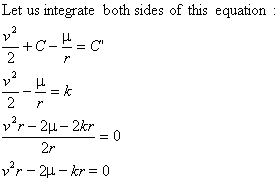
Therefore, we have that the speed of a body in elliptical motion is:
 3.3
3.3
Equation 3.3 is known as the Energy
integral or also as the Vis-Viva
integral.
Now, the speed of the body at its
pericenter and apocenter (through the use of equations 3.1, 3.2 and 3.3)
are:
 3.4
3.4
 3.5
3.5
From the angular momemtum
conservation law earlier proved, we can state that, due to the
perpendicularity of the velocity and position vectors, that:
 (by equation 2.7A)
3.6
(by equation 2.7A)
3.6
Squaring both sides of this
equation, we obtain:
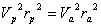
Finally:
 3.7
3.7
Based on the above, we can
conclude then that the speed of a body in elliptic movement under the
action of gravity is:
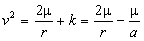
 3.8.
3.8.
Also, from equation 3.8 we can
easily calculate the speeds at pericenter and apocenter by recalling
equations 3.1 and 3.2:
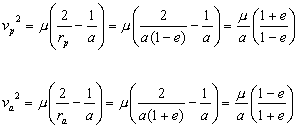 3.9
3.9
The ratio of theoretical maximum
(apocenter) and minimum (pericenter) speeds is found to depend solely on
the eccentricity of the orbit, as follows:
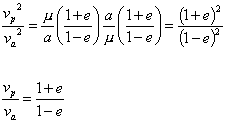
If we know proceed to make a
semi-logarithmic graph (figure 3.2) showing the above ratio for
different value of the eccentricity we obtain a rather linear behavior
up to an eccentricity of 0.8 and quite exponential from this point until
right before 1.0 which from that point onwards the orbit will become
open and cease to maintain a periodic movement.
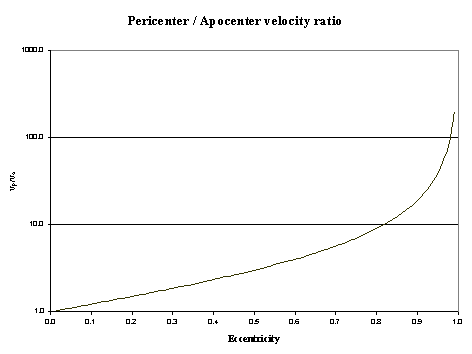
Figure 3.2
For a circular orbit., ie. with
zero eccentricity, its speed is directly calculated as:
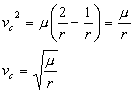 3.10
3.10
It must be obvious to the reader
that in this case the speed is constant for all values of r,
being itself constant, and only depending on the mass of the body and
that of its central body, without any exchange of energy.
Period of elliptic orbits
We can see in figure 3.3 that the
horizontal component of the velocity of a body in elliptic movement is
simply v cos
, which can also be expressed as

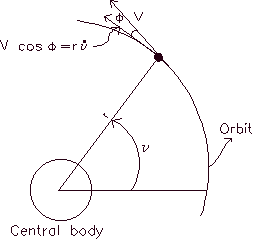
Figure 3.3
Recalling the angular momentum
equation:

we can state that:

Now, solving for dt, we obtain:
 3.11
3.11
|