|
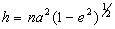
Obviously, for
each planet, this expression is constant and thus we have verified
Kepler’s second law. Additionally,
when the planet moves from SP to SQ the radius vector sweeps an angle
in
an interval of time
t. At point P, the angular speed is
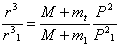
The third law,
mathematically expressed is:
where r
and r1 are the semi-major axes of two planets and P and P1 are their
respective orbital periods around the Sun.
By comparing
equation 4.8, obtained from Kepler’s third law, with the exact
relation found in equation 1.18 and after some Algebra, we can see that
it is in fact a very good approximation and we really obtain the
equation 1.19 previously discussed. Now, let us
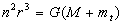
recall equation 1.14, for the Sun-Earth system:
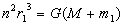
And for a
system Sun-planet:
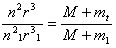
Combining
these two equations, we obtain:
Introducing
equation 1.7, we finally obtain:
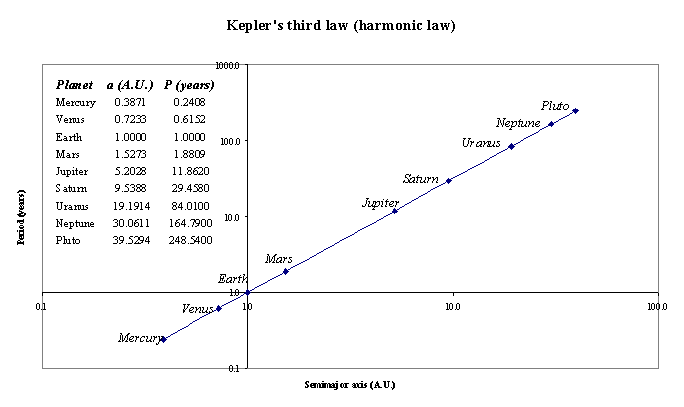
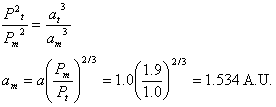
Graph 4.1 Determine the semi-major axis of Mars if
by observation we know that its orbital period is 1.9 years. Example 4.2. Using the data from example 3.1 from
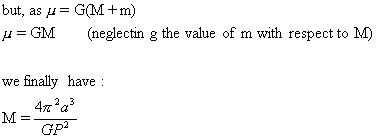
chapter 3, let us calculate the mass of the Earth.
We have used
for G :
The Equation of Kepler: Of all of the trascendental equations found in celestial mechanics and
mathematics in general, certainly few have generated so much study and
interest as the equation of Kepler. Quoting F.R. Moulton in his book "An
introduction to Celestial Mechanics" from 1914, we
recall "A great number of
analytical and graphical solutions have been discovered and almost all
of the greatest mathematicians since Newton until the mid of last
century have paid some of attention to the subject".
Additionally, he mentions that an incomplete list from 1900 already had
more than 123 papers about Kepler’s equation. In fact, there is a
recent book dedicated exclusively to the description and solution by a
large number of methods titled “Solving Kepler’s
equation over three centuries” Peter Colwell, Willmann-Bell Inc., 1993. Before we carry out
the derivation of Kepler’s equation, we shall introduce the concept of
orbital anomalies. These anomalies are simply auxiliary angles that
allow us to locate a planet on a given time considering its movement
along an ellipse with a determined eccentricity. Geometry of the planetary orbits As already thoroughly discussed
and proven, planets move in elliptical orbits around the Sun. In this
chapter we shall see several important parameters of the study of
elliptical movement under the influence of gravity. |